
Today, The Bible & You
Today’s Front Page
The Nation’s Christian Newspaper
July 2023
Forgiveness
From God’s Eternal Perspective & Purpose
“And be ye kind one to another, tenderhearted, forgiving one another, even as God for Christ’s sake hath forgiven you.” — Ephesians 4:32
Forgiveness is one of the pillars of faith throughout Scripture. The first use of the word “forgive” or related concepts in the Bible is in Genesis chapter 50, where Joseph’s family ask for forgiveness for selling him into slavery. We read in Genesis 50:15-21, “And when Joseph’s brethren saw that their father was dead, they said, Joseph will peradventure hate us, and will certainly requite us all the evil which we did unto him. And they sent a messenger unto Joseph, saying Thy father did command before he died, saying, So shall ye say unto Joseph, Forgive, I pray thee now, the trespass of thy brethren, and their sin; for they did unto thee evil: and now, we pray thee, forgive the trespass of the servants of thy father. And Joseph wept when they spoke unto him. And his brethren also went and fell down before his face; and they said, Behold, we be thy servants.”

“And Joseph said unto them, Fear not: for am I in the place of God? But as for you, ye thought evil against me; but God meant it unto good, to bring to pass, as it is this day, to save much people alive. Now therefore fear ye not: I will nourish you, and your little ones. And he comforted them, and spake kindly unto them.”
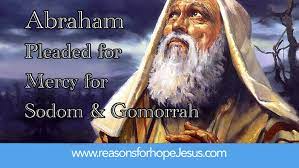
However, the concept is certainly earlier than that, for example in Genesis chapter 18 where Abraham asks God to spare the cities of Sodom and Gomorrah if ten righteous people are found there. After all, who hasn’t heard of the command to “turn the other cheek?” Forgiveness needs to be one of the main attributes in the life and character of anyone who has been born of the Spirit in Christ through whom, as we die to self, our Lord Jesus who lives in us will forgive them through us. This is why we have been redeemed by our Lord Jesus so that He could continue living His life on this earth through us.

When our Lord Jesus taught about prayer, he repeated three times in three verses about our need to forgive others in Matthew 6:12-15:
“And forgive us our debts, as we forgive our debtors. And lead us not into temptation but deliver us from evil: For thine is the kingdom, and the power, and the glory, forever. Amen.”
“For if ye forgive men their trespasses, your heavenly Father will also forgive you: But if ye forgive not men their trespasses, neither will your Father forgive your trespasses.” The word “forgive” appears six times in these three verses.
There are THREE rules to grow in Christ Jesus in His Word.
1.) READ Scripture daily.
2.) INTERPRET and UNDERSTAND the Scripture your READ daily.
3.) APPLY the Word of God you understand.
Forgiveness is the heart of the gospel and is a crucial factor in our growth in the intimate personal relationship God established with us when He washed our sins away in His blood and began living His life in and through us.

WHAT IS TRUE FORGIVENESS?
THE OPPOSITE OF REVENGE: We need to talk about revenge because revenge is the opposite of forgiveness. In the Sermon on the Mount, our Lord Jesus taught:
“You have heard that it has been said, An eye for an eye, and a tooth for a tooth: But I say unto you, That you resist not evil: but whosoever shall smite you on thy right cheek, turn to him the other also.” (Matthew 5:38-39)

God teaches about forgiveness as contrast to revenge. Seeking revenge means storing anger and bitterness inside, and it has two consequences:
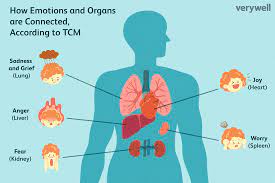
First not only does it hurt our relationships, it also has damaging implications on our health, because bitterness is something that eats us up from the inside. According to the research of Dr. Loren Toussaint and Dr. Grant Shields, unforgiveness directly affects the immune system, blood pressure, and the physical health and well-being of the heart.

Second, revenge hurts others and leads to a never-ending cycle of revenge. Forgiveness sets us free from the vicious cycle and can turn our sworn enemies into our greatest friends.

Understanding the purpose of forgiveness in Genesis 50 when Joseph forgave his brothers, will set you free to be a fruitful vessel of God. This is how Joseph responded to his brothers who asked Joseph to forgive them. Joseph tells his brothers in Genesis 50:19, “Joseph said unto them, Fear not: for am I the place of God? But as for you, ye thought evil against me; but God meant it unto good, to bring to pass, as it is this day, to save much people alive.”

“You have heard that it has been said, ‘An eye for an eye and a tooth for a tooth.'” (Matthew 5:38)
When our Lord Jesus made this statement, he was referring to a passage in Exodus 21, in which the Law of Moses sets the boundaries for revenge and introduces for the first time the principle of proportionality. If your neighbor punches you in a fight and breaks your tooth, you can’t take revenge by stabbing him with a knife. “A tooth for a tooth.” The Law of Moses was meant to set boundaries and to restrain the human heart which seeks revenge so that the revenge would be in proportion to the damage done. It’s important to understand that the Law of Moses does not represent the ultimate moral principles of God, principles of grace, compassion, and forgiveness. Not at all, rather it was God’s temporary compromise making this clear in the New Testament:
“He says unto them, Moses because of the hardness of your hearts suffered you to put away your wives: but from the beginning, it was not so.” (Matthew 19:8)
If Moses set boundaries and restraints, our Lord Jesus raised the standards back to God’s ultimate moral principles. Rather than starting a vicious cycle of revenge — forgive. Note that our Lord is talking about taking revenge on the offender, and not about taking revenge on the offense itself.

In other words, he is not saying that going against evil, protecting ourselves, or seeking justice is forbidden, rather we are being told to not take revenge on the person who hurt us but to pray for them.
Later on, in his epistle in the Romans, God writes similar words and elaborates:
“Recompense to no man evil for evil. Provide things honest in the sight of all men. If it be possible, as much as lies in you, live peaceably with all men. Dearly beloved, avenge not yourselves, but rather give place unto wrath: for it is written, Vengeance is mine; I will repay says the Lord.” (Romans 12:17-19)
“But I say unto you, That you resist not evil: but whosoever shall smite you on thy right cheek, turn to him the other also.” (Matthew 5:39)

In Scripture, to slap someone’s right cheek one needs to use the back of the hand — a degrading and humiliating act against someone. During the second temple period, this was used especially by the Roman guard. — when a Roman guard would (justifiably or not) slap a common citizen. Many of the Jews would be so humiliated to receive such treatment from a Roman Gentile that they would lose their temper and fight back; not against the evil itself but against the evildoer — the Roman guard — and would strike him back.

As believers, we need to learn to suffer injustice when peace and forgiveness are the objectives, even if it means suffering physical harm, losing property, or enduring mistreatment. And all this, by the way, was exactly what our Savior Jesus endured for us — he suffered injustice so that we could receive grace and peace. As an example, from our times: Say a police officer strikes you and humiliates you — you need to take him to court and not try to hit him back. It is further written in 1st Peter 3:9:
“Not rendering evil for evil, for railing for railing: but contrariwise blessing; knowing that ye are thereunto called, that you should inherit a blessing.” As was the case with Joseph and his evil brothers, God has a purpose when He allows us to be put in these situations. When we fulfill God’s purpose by responding to an evil deed with a blessing, God has a special inheritance prepared for us to inherit.

A few chapters later, in chapter 18, one of Jesus’ disciples, Simon Peter, asked Him: “Then came Peter to him, and said, Lord, how often shall my brother sin against me, and I forgive him? till seven times? Jesus says unto him, I say not unto thee, Until seven times: Until seventy times seven.” (Matthew 18:21-22)
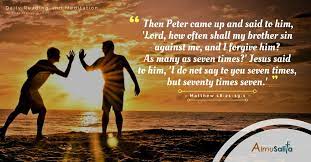
Our Lord Jesus is not saying that by the 78th time it’s ok to not forgive anymore, rather he is basing his answer on Genesis 4:24 and is using the symbolic number 7 to represent something infinite and perfect. If we are called to forgive over and over again, then we can be sure that God also forgives us over and over again. Our Lord Jesus continued and told His disciples a parable:
“Therefore, is the kingdom of heaven likened unto a certain king, which would take account of his servants. And when he had begun to reckon, one was brought unto him, which owed him ten thousand talents. But forasmuch as he had not to pay, his lord commanded him to be sold, and his wife, and children, and all that he had, and payment to be made. The servant, therefore, fell down, and worshipped him, saying, Lord, have patience with me, and I will pay you all. Then the lord of that servant was moved with compassion, and loosed him, and forgave him the debt. But the same servant went out, and found one of his fellow servants, which owed him a hundred pence: and he laid hands on him, and took him by the throat, saying, Pay me that you owe. And his fellow servant fell down at his feet, and besought him, saying, Have patience with me, and I will pay you all. And he would not: but went and cast him into prison, till he should pay the debt. So, when his fellow servants saw what was done, they were very sorry, and came and told unto their lord all that was done. Then his lord, after that he had called him, said unto him, O you wicked servant, I forgave you all that debt, because you desired me: Should you not also have had compassion on your fellow servant, even as I had pity on you? And his lord was angry, and delivered him to the tormenters, till he should pay all that was due unto him. So likewise, shall my heavenly Father do also unto you, if ye from your hearts forgive not everyone his brother their trespasses.” (Matthew 18:23-35)
A debtor who owed an enormous debt was brought before a king, a debt of 10,000 talents, amount worth millions today, and a debt that was obviously more than the person could pay. Therefore, the king ordered that the man, the man’s family, and his possessions be sold. This man did not deny his debt but asked for more time to pay the king back.
“And out of pity for him, the master of that servant released him and forgave him the debt.” (Matthew 18:27). The king decided to forgive his debt.

Note the three elements of forgiveness:
-
To have mercy
-
To release
-
To pardon
For instance, say I borrowed a friend’s car and accidentally wrecked it. If my friend decides to have mercy on me, it means that he decided not to be angry with me and to not let the incident hurt our relationship. However, I still owe him money to cover the repairs of the damage done to his car. If my friend also releases me from my debt, it means that he decided to take care of the repairs himself and to not ask me to return the money. This doesn’t mean that the cost for the repairs just disappeared — rather that my friend covered that cost from his own pocket in my stead. He paid the debt that I was supposed to pay. If my friend decides to pardon me as well, it means that he decided not to hold a grudge against me now or in the future, in other words, he is willing to lend me his car again.

My friend could have just had mercy and forgiven me for my mistake yet demand that I cover the costs. He could have released me from my debt but decided to cut off all communication with me. He could have had mercy on me, forgiven me for my mistake, and even released me from my debt, but refuse to lend me his car in the future.
But he was such a good friend that he not only had mercy on me, but also forgave me, discharged me from my debt, and covered the costs that I was supposed to pay — he even agreed to lend his car in the future.
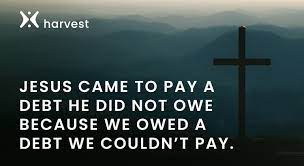
This is true and perfect forgiveness. This friend sounds too good to be true, right? Yet this is the kind of forgiveness God gave us through the Messiah, our Redeemer and Savior, and the kind of forgiveness that He wants to extend to others through His indwelling presence in us.

OUR LORD JESUS CAME TO DO JUST THIS: He took our sins upon Himself and by His blood paid our debt for us and in our stead. It is written in Colossians:
“Forbearing one another, and forgiving one another, if any man have a quarrel against any: even as Christ forgave you, so also do ye.” (Colossians 3:13)
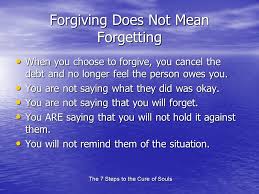
We also need to be able to forgive others for sins they have committed against us. Whoever truly understands the depth of forgiveness which our Savior gave us will surely be able to forgive others as well.
“But the same servant went out, and found one of his fellow servants, which owed him a hundred pence: and he laid hands on him, and took him by the throat, saying, Pay me what you owe. And his fellow servant fell down at his feet, and besought him, saying, Have patience with me, and I will pay you all. And he would not: but went and cast him into prison, till he should pay the debt.” (Matthew 18:28-30)
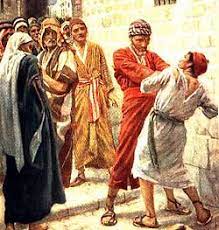
How ironic it is that a moment ago you were forgiven, but now you yourself are unable to forgive another. The forgiven is unable to forgive. This is a true picture of mankind. Aren’t we all like that? We all want to be forgiven, but we’re not so quick to forgive others.
When someone sins against you and hurts you, you want to see justice done. You demand that justice be done!

When someone sins against you and hurts you, there are two ways you can respond: The first, is to remove that person from your life, take revenge, and hope that person will suffer as well, and when they have suffered enough, only then will you feel that they paid the price for their deeds. This is the response the Devil wants you to choose.
The alternative is our Lord Jesus. God wants every believer to “live by faith,” in response to God’s revealed Word. Faith demands us to remember that we also were forgiven and that’s why we choose to pay the price in place of the person who’s hurt us.
Forgiveness isn’t easy at all and often times it’s counter cultural. It’s important to understand that forgiving someone doesn’t mean allowing them to continue to hurt you or sin against you. Forgiveness also doesn’t dismiss the accountability of the offender, but rather that it chooses to show grace despite the offense. True forgiveness comes when we “DIE TO SELF” and allow our Lord Jesus to forgive through us. God tells us in Romans 5:6, 8, 10, “For when we were yet without strength, in due time Christ died for the ungodly. . . But God commends his love toward us, in that, while we were yet sinners, Christ died for us. . . For if when were enemies, we were reconciled to God by the death of His Son, much more, being reconciled, we shall be saved by his life.”
Forgiveness isn’t a feeling. We never really feel like forgiving — it is DYING TO SELF, so that CHRIST JESUS CAN LIVE HIS LIFE THROUGH US BY FORGIVING THROUGH US. a dead person has no feelings — cannot hold any resentment.
“For it is God who works in you BOTH to WILL and to DO of his good pleasure.” (Philippians 2:13)

FORGIVENESS PAVES A PATH OF
REPENTANCE FOR THE ONE WHO’S
BEEN FORGIVEN
Forgiveness means choosing to have mercy on the one who’s sinned against you, in order to not damage the relationship. Forgiveness is choosing to release the one who’s sinned against you from the debt he owes you. And forgiveness is choosing to set that person free, pardon him, and give him grace now and in the future, and not hold a grudge against him in the future.

“Then his lord, after that he had called him, said unto him, O you wicked servant, I forgave you all that debt, because you desired me: Should you not also have had compassion on your fellow servant, even as I had pity on you? And his lord was angry, and delivered him to the tormenters, till he should pay all that was due unto him. So likewise, shall my heavenly Father do also unto you, if ye from your hearts forgive not everyone his brother their trespasses.” (Matthew 18:32-35)
In this parable, we get to take a close look at the man’s heart. He knows how to beg for forgiveness from others, but he doesn’t acknowledge the forgiveness that was given him and that’s why he is unable to forgive others.

Our human nature is an expert at self-justification. “Me? Of course, I deserve forgiveness!” But we all know how to blame others: When we’re in the wrong, suddenly the situation can be explained away through context and surrounding circumstances.

When we realize that we sin exactly like everyone else, without exception, we stop looking down on others and acknowledge the fact that we too need forgiveness, that we too have been forgiven an enormous debt — and that’s why we forgive others.

Printed with permission of Today, The Bible & You located at P.O. Box 1722 Broken Arrow, Oklahoma 74013, Phone No. (918) 279-1136. The name of the original article in the July 2023 issue of Today’s Front Page was “FORGIVENESS: From God’s Eternal Perspective & Purpose” www.JohnBarela.com.
 Learn Biblical